Real-time Firebird – Monitor for Firebird – Server 2.5 – 5.0
A new version 2.0.7.203 is available.
Visit our homepage and download the demo version.
Firebird related news
A new version 2.0.7.203 is available.
Visit our homepage and download the demo version.
For those who can’t wait for QNAP to release the new versions in the official QNAP App Store, here is the download link.
Firebird 3.0.14 / 4.0.7 / 5.0.4 for Intel QNAP NAS (intel only) can be downloaded via the follow link
Mustafa on Firebird-general group : I would like to introduce my continued development of TurboBird. The tool was originally developed by Abdel Azem Motaz, but was discontinued around 2015. I took over the code about a year ago and have been continuously developing, modernizing, and extending it since then.
TurboBird is a Lazarus (FreePascal) project and is currently cross-platform, supporting both Linux and Windows.
The biggest step was the complete removal of SQLDB:
Additionally, the project now features dynamic loading of Firebird client libraries and parallel use of multiple Firebird versions (2.5 → 6.0) within a single instance. Thanks to IBX, script execution with and without terminators is now possible.
The TreeView has been completely reworked with Lazy Loading (objects are loaded only when expanded), significantly reducing initial load times. Performance remains stable even with very large catalogs, having been tested with:
The Activity Monitor provides a display of attachments, transactions, and statements, with the ability to directly terminate attachments or statements when necessary.
Migration to IBX (Tony Whyman code) has enabled:
This is more than just maintenance—it is a large-scale technical refactoring and functional extension. I would be very interested in your feedback, especially regarding tests with different Firebird versions, edge cases, or general ideas.
Best regards,
Mustafa
We have been working on a significant overhaul of the official firebird-docker images, and a pre-release version is now available for testing at:
👉 Pre-release Container Registry
We would love to get feedback from the community before these changes are merged upstream.
The new images include a 6-snapshot tag built daily from the master branch of FirebirdSQL/firebird. This is the first time a Firebird 6 development snapshot has been available as a Docker image.
# Pull the latest Firebird 6 development snapshot docker pull ghcr.io/fdcastel/firebird:6-snapshot # Pull the latest Firebird 5 patch snapshot docker pull ghcr.io/fdcastel/firebird:5-snapshot
Snapshot images are rebuilt daily, so you always get the latest development build.
The image matrix has been significantly expanded to cover more versions and distributions:
Pull the images directly from our pre-release registry to see how they perform in your environment:
Bash
# Latest stable (Firebird 5.0.3 on bookworm) docker pull ghcr.io/fdcastel/firebird:latest # Firebird 6 development snapshot ← Most wanted testers here! docker pull ghcr.io/fdcastel/firebird:6-snapshot # A specific version + distro docker pull ghcr.io/fdcastel/firebird:5.0.3-jammy docker pull ghcr.io/fdcastel/firebird:4.0.6-bookworm
These images have not yet been merged into the official repository and may contain bugs. The Firebird 6 snapshot, in particular, is built from unreleased, in-development code.
Warning: Do not use pre-release or snapshot images in production environments. Snapshot tags (6-snapshot, 5-snapshot) are rebuilt daily and do not carry stability guarantees.
Your input is vital to making these images solid before the official merge. Please report any issues, successful test results, or suggestions at the upstream pull request:
Whether it’s a simple “works great on my ARM64 machine” or a detailed bug report, all feedback is welcome.
Thank you for helping us improve the Firebird ecosystem!
— F.D. Castel
FlameRobin 0.9.16 released focuses on: modernizing CI/build tooling fixing compiler/linker issues , improving packaging (Flatpak), and delivering a set of Firebird metadata/DDL extraction and SQL editor correctness improvements
We’re happy to share the Firebird ODBC Driver v3.5.0-rc1 release candidate, published on April 11, 2026. This RC focuses on improved Windows/ARM64 support, modernized build and CI tooling, installer updates, and a number of compatibility and correctness fixes.
Release page: https://github.com/FirebirdSQL/firebird-odbc-driver/releases/tag/v3.5.0-rc1
This release candidate includes the following changes and merged pull requests:
Full changelog comparison: https://github.com/FirebirdSQL/firebird-odbc-driver/compare/v3-0-1-release…v3.5.0-rc1
You can grab prebuilt artifacts from the release assets. This RC includes:
Download them from the GitHub release page (linked above) and test in your environment—especially if you rely on specific ODBC client tools, BI integrations, or custom applications.
Release candidates are published to collect real-world feedback before a final stable release. If you can, please test v3.5.0-rc1 on your key workflows (connectivity, metadata discovery, parameter handling, and installer behavior on Windows) and report regressions or edge cases.
If you hit problems, file an issue on the project tracker with details about OS, architecture (x86/x64/ARM64), Firebird version, client application, and a minimal repro if possible.
Issues: https://github.com/FirebirdSQL/firebird-odbc-driver/issues
Github Action : Setup FirebirdSQL updated to 2.2: What’s Changed :
Add volumes input for mounting host directories into the Firebird container.
Add event_port input to enable Firebird RemoteAuxPort (events support).
This GitHub Action sets up a Firebird database running on a docker container.
PSFirebird is a PowerShell module focused on automating Firebird environments, databases, and common administrative workflows. The main goal is to make Firebird easier to script end-to-end without depending on a manual installer flow or a machine-specific setup.
The problem is trying to solve was simple: working with Firebird in automation often means mixing shell scripts, ad hoc local installs, version-specific quirks, and CI setup glue. That gets especially painful when you need to test multiple Firebird versions, rehearse upgrades, or spin up disposable databases for integration tests. PSFirebird is designed to reduce that friction.
Today the module can:
The current codebase targets PowerShell 7.4+ on Windows and Linux. On Linux, the environment bootstrap currently targets Debian-based systems.
PSFirebird is not meant to be another GUI admin tool. It is aimed at repeatable automation.
Some scenarios where it should be useful:
One of the most useful parts for me is the ability to create isolated Firebird environments directly from PowerShell, then run the rest of the workflow against that environment in a predictable way.
This project builds on earlier work I’ve done across several Firebird community initiatives such as SqlAlchemy-Firebird, the Firebird .NET Provider, the Firebird ODBC Driver, and the Python driver. Across all of these efforts, maintaining a robust and consistently repeatable testing foundation has been essential.
Here is a small example that prepares two Firebird versions and converts a database from one environment to another:
$tempPath = [System.IO.Path]::GetTempPath() $fb3 = New-FirebirdEnvironment -Version '3.0.12' -Path (Join-Path $tempPath 'fb3') $fb5 = New-FirebirdEnvironment -Version '5.0.3' -Path (Join-Path $tempPath 'fb5') $sourcePath = Join-Path $tempPath 'legacy.fdb' $targetPath = Join-Path $tempPath 'legacy.fb50.fdb' $db = New-FirebirdDatabase -Database $sourcePath -Environment $fb3 -Force $env:ISC_USER = 'SYSDBA' $env:ISC_PASSWORD = 'masterkey' Convert-FirebirdDatabase -SourceDatabase $db -SourceEnvironment $fb3 -TargetDatabase $targetPath -TargetEnvironment $fb5 -Force
The module also includes helpers for scoped environment usage, configuration editing, SQL execution, service management, and database statistics collection.
This is a real automation-oriented codebase, not just a thin proof of concept. The repository already includes:
If you work with Firebird, I would especially like feedback on:
GitHub repository: https://github.com/fdcastel/PSFirebird
If this looks useful for your environment, take a look and let us know what would make it more practical for real-world Firebird automation.
As part of an ongoing effort to improve the project’s infrastructure, we have just merged Pull Request #281, which introduces a modern CMake build system and drastically cleans up our repository by removing over 62,000 lines of obsolete configurations, old headers, and broken test projects.
This is the second phase of a three-part plan to streamline how the Firebird ODBC Driver is built and maintained.
Building the Firebird ODBC driver is now easier and more standardized. We’ve introduced a CMake build system that handles building the FirebirdODBC.dll driver, the IscDbc static library, and running our test suite via CTest.
One of the major improvements is that the build system now automatically downloads the Firebird 5.0.2 public headers from GitHub at build time, meaning we no longer have to manually vendor them in our repository.
For developers who prefer the existing Visual Studio 2022 solution, don’t worry—it still works! You simply need to run a one-time CMake configuration step to fetch the headers before opening the solution as usual.
Over the years, the repository accumulated a lot of build configurations for platforms and compilers that have long been discontinued. In this update, we did some massive spring cleaning:
While the infrastructure has seen a massive overhaul, the driver source code itself remains completely untouched. There are no changes to the source files, no new features, and no performance alterations.
We heavily validated the new CMake build against the old build system, confirming that the output FirebirdODBC.dll is perfectly binary-compatible and exposes the exact same 120 exported symbols as before.
Thanks to @fdcastel for authoring this massive infrastructure improvement!
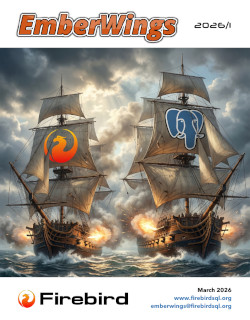
With Firebird’s 25th anniversary behind us, this edition looks forward, focusing on the challenges of understanding and operating long-lived database systems. It explores how performance and behavior often emerge from interactions across the system, rather than from isolated components, and examines how database vulnerabilities are assessed and interpreted in practice.
As always, the issue is presented in a clean, print-friendly layout designed for enjoyable reading, whether on screen or on paper.
The latest issue is available only to all Firebird Associates and Firebird Partners. It will be available to the general public in June 2026.
Also, the December 2025 issue is now available to all readers.